
Easy Steps to Write A Reflective Midwifery Assignment

Have you been told to write your reflective assignment using Gibbs’ Reflective Cycle for your midwifery program, and you’re just sitting and staring at a blank page, unable to figure out what exactly to do? I can understand how difficult that is, but don’t worry, because almost every midwifery student goes through this phase while writing their reflective assignments.
Like other disciplines, students in the midwifery field are required to write reflective assignments where they have to briefly explain a certain experience based on their theoretical knowledge and analysis of their clinical placements.
Even if you are well aware of what it is, you might still be wondering, ‘How should I actually use every stage of Gibbs’ Reflective Cycle in my reflective midwifery assignment?’
In each stage, you will have to prove how you can examine your feelings, apply your evidence-based research to that particular situation, and explain what you have learned from the situation that can help you improve your future practice as a midwife.
Let me help you cope with this anxious situation, as I have shared everything you need to know about the Gibbs’ Reflective Cycle. Moreover, I have included the step-by-step process to help you understand how you can use each stage of the cycle for your reflective assignment.
Let’s get started; make sure you don’t miss anything!
A Quick Overview of the Gibbs’ Reflective Cycle
When you look up different articles, you will come to know that Gibbs’ Reflective Cycle enables you to reflect on your past experiences and learn from them, rather than just describing them.
Since it is a 6-stage cycle which involves the steps or stages named as Description, Feelings, Evaluation, Analysis, Conclusion and Action Plan, the circular format shows that it is an ongoing process and you can continuously improve your future practice.
I have explained how you can use each of the stages while writing your midwifery course’s reflective assignment in detail below, but for your better understanding, I am sharing an overview of the stages in this table here:
|
Stages |
What They Are Called |
|
Stage 1 |
Description (what happened) |
|
Stage 2 |
Feelings (your thoughts and emotions during that situation) |
|
Stage 3 |
Evaluation (assess your experience by highlighting what went well and what did not) |
|
Stage 4 |
Analysis (find out why things happened in a certain way) |
|
Stage 5 |
Conclusion (briefly explain what you learned and what you would do in the exact situation) |
|
Stage 6 |
Action Plan (devise a strategy for the future) |
Why is it Ideal for Your Reflective Midwifery Assignment?
The Gibbs’ Reflective Cycle is usually the most suitable approach, as it directly aligns with the reflective practice guidelines and requirements from the NMC. It helps students balance the intense emotional situations with clinical evaluation and bridges the gap between their theoretical knowledge and clinical practice.
If you are still thinking, ‘Why should I use Gibbs’ Reflective Cycle for my reflective assignment?’ I have explained this in detail:
-
You can separate your emotions from analysis
As you know, midwifery is one of the healthcare fields that requires you to work in intense, high-stakes, and emotional situations. And your midwifery assignment topics can range from dealing with complicated labour to emergency interventions without making rushed decisions.
The Gibbs’ Feelings stage allows you to describe what you felt in specific stressful situations before, during, and after the event.
-
It encourages your critical thinking capabilities
Among other stages of Gibbs’ Cycle, the Evaluation and Analysis phases are what help students break down everything by going beyond describing a simple story. It means you have to explain why things happened in a certain way using evidence.
By learning how to move your assignment from a narration into describing an event using your critical thinking, you can improve your analytical skills and your ability to implement your critical thinking into real-life scenarios.
-
You can integrate your theoretical knowledge with clinical practice
By using the Gibbs’ Reflective Cycle, you can break down how your actions align with the theories from your textbooks and your experiences from the previous clinical placements.
For instance, you may have to explain how you used your theoretical knowledge to manage a complicated labour, or handle any other complex situation.
-
It improves your action-oriented growth
The Action Plan and Conclusion stages of Gibbs’ Cycle help you transform a single challenging birth into a targeted learning objective for your future placements. This way, you can have a deeper understanding of your role as a midwife and create a solid, evidence-based plan.
Still confused about whether Gibbs’ Cycle is good for effective learning and your reflective assignments? Then, read our guide on Gibbs’ Reflection Theory to clear your concepts and gain a better understanding.
Steps to Write Your Reflective Assignment Using the Gibbs Cycle
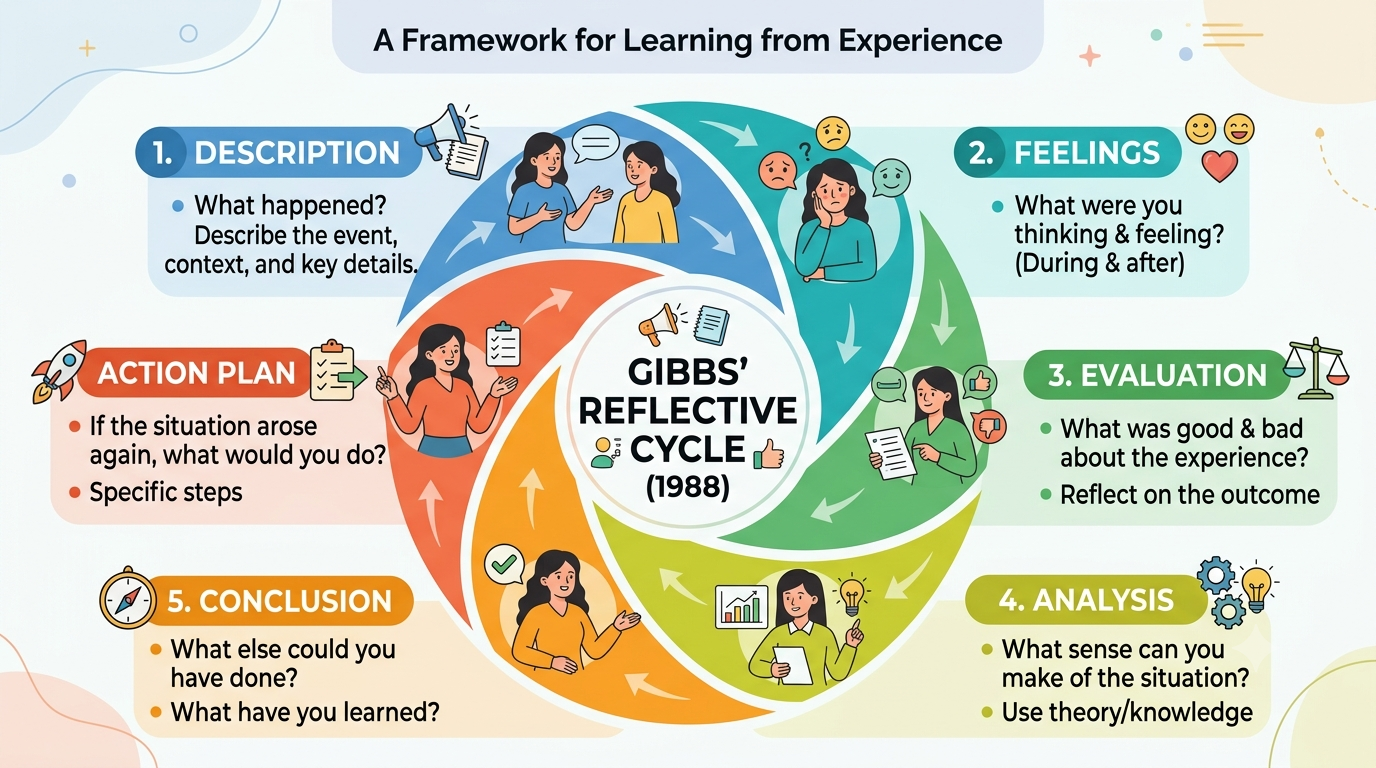
Using the Gibbs’ Reflective Cycle, you can write your reflective midwifery assignment by stating what happened, describing what you felt in that situation, presenting your judgement of what went well and what did not go according to your plan, and breaking down why things happened in a specific way. Then, you have to explain what you learned from your experience and what you will do differently in a similar situation in your future practice.
If you’re baffled by the short description, don’t feel stressed, as I have explained how you can use each phase in your reflective assignment:
Stage 1. Description (Stating What Had Happened)
In the first stage, you have to describe the situation in the exact manner without including your personal judgments or interpretation.
For that, you will have to begin by creating a concise view of the scene, by presenting your answers to these questions:
-
Who was involved?
-
Where did the particular situation take place?
-
What did you do?
-
What was the outcome?
Remember that you have to mention (not analyse) a specific clinical scenario, such as supporting a mother through early labour or an antenatal check. Here, you have to stick to the facts and use pseudonyms so that you can maintain the patient’s confidentiality.
|
Feeling stuck on incorporating the first stage of the Gibbs’ Cycle into your reflective assignment? Let our midwifery assignment experts assist you in composing a well-written assignment using each stage of the Gibbs’ Reflective Cycle without mistakes. Contact our professionals today! |
Stage 2. Feelings (Describing What You Were Thinking And Feeling)
At this stage of your reflective assignment, you will have to briefly explain your emotional response before, during, and after that particular situation. To avoid making mistakes here, you must ensure that you are describing your feelings rather than making it look like a diary entry.
An easy way you can share honest reflections is to answer these questions:
-
What were your feelings before the event?
-
What was your emotional response during that entire situation?
-
What were you feeling after everything returned to normal?
-
How did your emotional state impact your communication and the decisions you made?
Stage 3. Evaluation (Presenting a Judgment of What Was Good And Bad)
For this stage, you’ll have to make an honest, objective judgment of the entire experience. For instance, you have to explain what went well during a particular challenging birth scenario, what did not go according to your plan, and where you struggled.
With this type of approach, you can effectively follow the ‘reflection’ criterion of your reflective essays or other midwifery reflective assignments.
Stage 4. Analysis (Describing What Sense You Can Make of the Situation)
This stage helps you present your objective reasoning based on evidence, making it easier to explain why things happened in the way they did. Since it is the most critical section of your assignment, you must link your personal actions and decisions to the NICE guidelines, midwifery literature, and NMC standards.
For instance, you will have to analyse why a particular complication occurred in the context of physiological birth or Cesarean sections.
Stage 5. Conclusion: Stating What You Have Learned from the Experience)
For the conclusion stage of the Gibbs’ Cycle, you have to simply summarise what you have learned from the experience.
For that, you must highlight:
-
Your learning experience about the midwifery practice
-
What did you learn from your mistakes?
-
What could you have done differently to improve the outcomes of the situation?
Stage 6. Action Plan (Explaining What You Will Do Next Time)
At the last stage, you have to devise realistic steps that you will use in your future practice as a midwife. You must keep in mind that you have to present an actual outline of how exactly you will act and use your experience if you have to manage a similar clinical scenario again in the future. Also, you must write with a specified approach rather than using vague statements.
If you are struggling to write your assignment, I suggest that you explore our guide on the benefits of midwifery assignment help to write high-scoring assignments and seek academic support to improve your overall academic performance.
Frequently Asked Questions
-
Do I have to write reflective midwifery assignments in the first person?
Yes, most UK universities require you to write your reflective midwifery assignment in the first person, as you have to explain your ‘on-duty’ experiences and describe what happened, the causes, state what you learned and what you will change in a similar situation in the future.
-
Are reflective assignments only required in the midwifery programs?
No, you’re not limited to writing a reflective assignment only if you’re studying midwifery. Instead, nursing, medicine, education, and other health-related programs also require you to write reflective assignments to assess your critical thinking and analysis.
-
What word count should I follow for my midwifery reflective essay?
There is no standard word count for midwifery reflective essays, but these generally range from 1500-3000 words. However, you should check your assignment prompt thoroughly to ensure that you write your reflective essay in line with your university’s specific requirements.
-
What mistakes do students make in midwifery reflective assignments?
Many midwifery students lose marks on their reflective assignments because they fail to connect theory with clinical practice and struggle to avoid describing their personal feelings, which leads to deductions and impacts their overall grades.
-
How can I ensure that my actions are connected with the NMC standards in my midwifery assignment?
You can do that by citing the specific evidence-based theories of the Standards of Proficiency for Midwives and the NMC Code and explaining how your actions align with the particular theories.
Summarising the Final Thoughts
I totally get how stressful it is to write a reflective assignment, that too in the complex midwifery field. When I observe students getting confused while writing their reflective assignments, not just for the particular midwifery program but for any other health-related program.
Using the Gibbs’ Reflective Cycle for your reflective midwifery assignment, you can improve your understanding and ensure that you write a quality reflective assignment that connects your experiences to the practical theories.
Moreover, you can analyse your personal growth more and explain your professional learning experiences from your clinical placements and theoretical knowledge more effectively.
Good luck writing your reflective assignment using the Gibbs Reflective Cycle!

 English
 Arabic
 French
 Spanish
 Portuguese
 Deutsch
 Turkish
 Dutch
Dutch
 Italiano
 Russian
 Portuguese (Brazil)
 Greek
Greek